USD
USD
How to Choose the Right Hair Density for Your Men’s Hair System: A Stylist's Guide
Posted by Santana Fell on Oct 08, 2026
How Do I Choose the Density of My Hair System?
The short answer
The right hair system density is the one that matches your natural hair, not the one with the most hair. For most first-time wearers, that means starting lighter, somewhere around, and building up over time. Your base material, hair texture, and the style you want all change how dense a system looks on your head.
"Having more hair doesn't make you look younger, but having hair does." — Christina, Superhairpieces expert stylist, with 10 years of experience in the non-surgical hair replacement industry.
That one line from Christina sums up how to pick the density of your hair system. The goal isn't the most hair possible. It's hair that looks like it grew out of your scalp.
Key takeaways
- Match the system's density to your own biological ("bio") hair so the blend is seamless.
- Decide first whether you want natural or durable; you can't fully have both.
- First system? Go lighter, then increase density with your next unit.
- The same density looks lighter on skin and Swiss/French lace, and heavier on mono.
- Curly hair looks fuller than straight hair at the same percentage.
- When in doubt between two densities, choose the lighter one.
Why does hair system density matter?
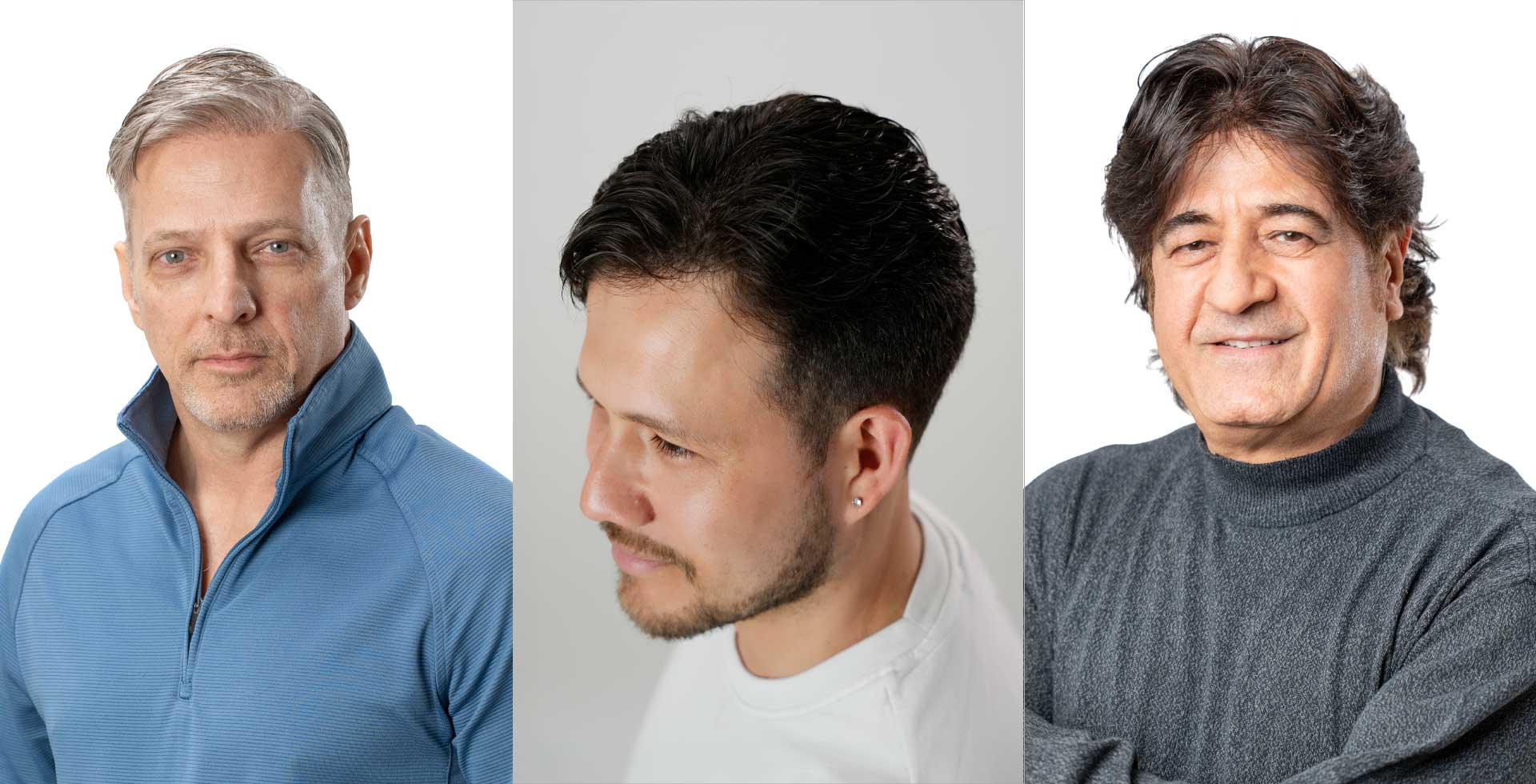
Density, meaning how much hair is on the base, is one of the most important choices you'll make, because it decides whether your hair system looks natural. It's also the hardest spec to judge from a product page. One brand's 100% can look different from another's, and the base material changes how full the same density appears; the same percentage can look lighter on a skin base than on a mono base. Online forums are full of people who regret their first system because they went too heavy or too light, so it's worth getting it right the first time.
It's tempting to go as full as possible, especially if you've missed having thick hair. But too much density is one of the most common giveaways. This might not make sense at first, but think about it: if a man in his fifties has thicker hair than most twenty-year-olds, people notice. Going too light creates its own problems: the base can show through, the hair looks thin, and the system can wear out faster as it sheds.
The goal is to match the density of your own remaining hair and what's typical for your age. That keeps the system blending in, comfortable to wear, and believable up close.
Understanding Hair System Density
To help you better understand density and why it matters, we sat down with Christina, one of our top Superhairpieces stylists, who fits and cuts men's hair systems every day. Everything below comes from her experience in the chair.
What is low, medium, and high density in a hair system?
Hair density is how much hair is knotted into the base, shown as a percentage. At Superhairpieces, light density is about 75–95%, light to medium is 100–115%, and medium to heavy is 120%. Heavy density is anything 130% or above.
Read: Must-Try Low-Density Hair Systems for Men: Superhairpieces 2026 Edition
What does the percentage actually mean?
It's a relative scale, not a strand count. Each manufacturer sets its own baseline for what 100% looks like, then goes up or down from there. That's why 100% from one brand can look noticeably different from another's, and why Christina says you can't compare brands on percentage alone.
| Density level | Typical % | Looks like | Often suits | Our examples |
|---|---|---|---|---|
| Extra light | 75–80% | Very sheer; the base can show through | Very fine bio hair, experienced wearers | M111XT, M111 |
| Light | 90–95% | Soft, natural, flat-lying | Most first-time wearers, fine or thinning hair | M115, M110, HD111 |
| Light to medium | 100–110% | Natural fullness | Average bio hair, most everyday styles | M105, M101, M106L, MD105 |
| Medium | 120% | Full | Naturally thicker bio hair, fuller styles | HD105, M103, M104 |
| Heavy | 130% or above | Thick | Very dense bio hair, high-volume styles | M102, M112 |
There's no industry standard, so that other brands may label the same percentages differently. "On Reddit, people say low density is 90 or below," Christina says. "Some see 100% and freak out because to them it's high density. To me, 100 isn't bad; it depends on the base."
Our own labels back her up: we class 100–110% as light to medium, the standard density for most of our men's stock systems.
That's also why comparing brands by percentage alone doesn't work. A 100% from one company can look like 90% or 110% from another because of how each one ventilates hair (How hair is knotted or injected into the base) and what base it uses.
Even within one brand, expect small differences. Human hair systems are hand-ventilated, so two orders of the same model and density can vary slightly.
Add:
Does the base material change how dense a hair system looks?
Yes, the base changes how dense a system looks as much as the percentage does. Thin skin and honeycomb lace (Swiss and French) let hair lie flatter and look lighter. Tightly woven mono bases make the same density look heavier because the knots and base are more visible and the hair stands up more.
"On Swiss lace or skin, 80% or 100% is going to look a lot less dense and more natural," Christina explains. "As soon as we change to French lace or a mono base, the material is more tightly woven, so you see the base more, and it looks more dense."
Mono is square-woven, with four corners around every knot. That makes the hair less pliable. "When you're trying to style it, it just flops back to the side," she says. Honeycomb lace lets hair settle and flow, and skin lies the flattest of all with no visible knots.
| Base | How density reads | Best for |
|---|---|---|
| Thin skin/poly | Lightest-looking, very flat, no visible knots | Exposed hairlines, the most natural look |
| Swiss lace (honeycomb) | Light and natural, flows well | Natural look plus breathability |
| French lace (honeycomb) | Slightly heavier than Swiss, still natural | Balance of natural and breathable, not as delicate as Swiss lace |
| Mono | Heaviest-looking, hair lifts and flops | Can hold higher density, durability |
Each base also has a practical density limit. Delicate bases shed faster when they carry too much hair, so as a rule of thumb:
- Thin skin/poly: up to about 100%
- Lace: up to about 120%
- Mono: 130% and above
Which base is best for high-density and low-density systems?
- High density: mono systems (such as our 104 line) are the most durable, though not the most natural.
- Low density: choose the thinnest base you can, like Swiss lace or thin skin. A thick base with little hair on it shows through.
- Hybrid systems like the M158 or M159 work well when you style your hair down or forward. Their skin or poly front is thick, so an exposed, swept-back hairline can show it.
For natural-looking density, Christina recommends the M106L, HD 105, or MD 105. The MD 105 sits in a comfortable middle-to-dense range.
How to Pick Your Hair System Density: Stylist’s Guide
Match the system to the density of your own remaining hair, usually on the sides and back.
Compare your bio hair with the density on the system. That's the most reliable way, especially for a first purchase.
"There's nothing worse than a really dense piece on top and really thin bio hair, because then you see the disconnect," Christina says. "No amount of thinning is going to make it look good."
Step 1: Choose between natural or durable
Christina asks every client this first. Natural looks and durability don’t go hand in hand in the hair system world. “You've got to pick your battles."
- Natural: lighter density on a thinner base. It blends in seamlessly but won't last as long, so you'll replace it more often.
- Durable: more hair on a thicker base. It lasts longer and costs less to keep up, but it can look heavy and disconnected from your own hair if you don’t have good density in your bio hair.
Most clients choose natural once they hear both options side by side.
Step 2: Look at your bio hair, not your memory of it
Many men describe their hair as thin because they remember how thick it used to be. "They're like, 'If you knew how much hair I had before,'" Christina says. "But there's still a lot of hair. I'm not going to give you the same density you had back then; I match it to what you have now."
Natural density also varies by hair type and color. Afro-textured, Asian, and Caucasian hair all differ, and hair color plays a part too. That's another reason to match a system to your own hair rather than to a general chart.
Step 3: Factor in your style and base
The hairstyle you want decides which system can achieve it. "It's not even about the fit of the system," Christina says. "It's about the style they're trying to achieve and whether that system can do it."
How does a stylist assess your natural density?
Christina and all of our stylists look at your thinning areas and at where your hair is still strong, usually the sides and back. They compare that with the systems they use every day. They also ask about your lifestyle and goals: Are you active? Is your scalp oily? Do you sweat a lot? What style do you want? Etc., to figure out the best hair system for your lifestyle and daily needs.
"I ask them all those questions, then factor in what's best suited for them and determine it by looking at their density," Christina says. Density is one part of the recommendation, alongside base, adhesive, and style.
Our consultants follow the same approach. They ask you to rank budget, durability, and a natural look. They also note your density, color, grey percentage, and hairstyle, and use a density ring and color ring to compare samples against your own hair.
Can I choose density myself without a consultation?
Experienced wearers who already know their density can order on their own. First-time wearers should book a consultation. You don't yet know a brand's materials or how its percentages look in person, and there's no reliable way to estimate your own hair from a mirror.
You can book a free online consultation with Superhairpieces, and we can guide you to the right density and hair system. Color ring samples help you match your shade before ordering, and you can have your system shipped to a local stylist for fitting and cutting.
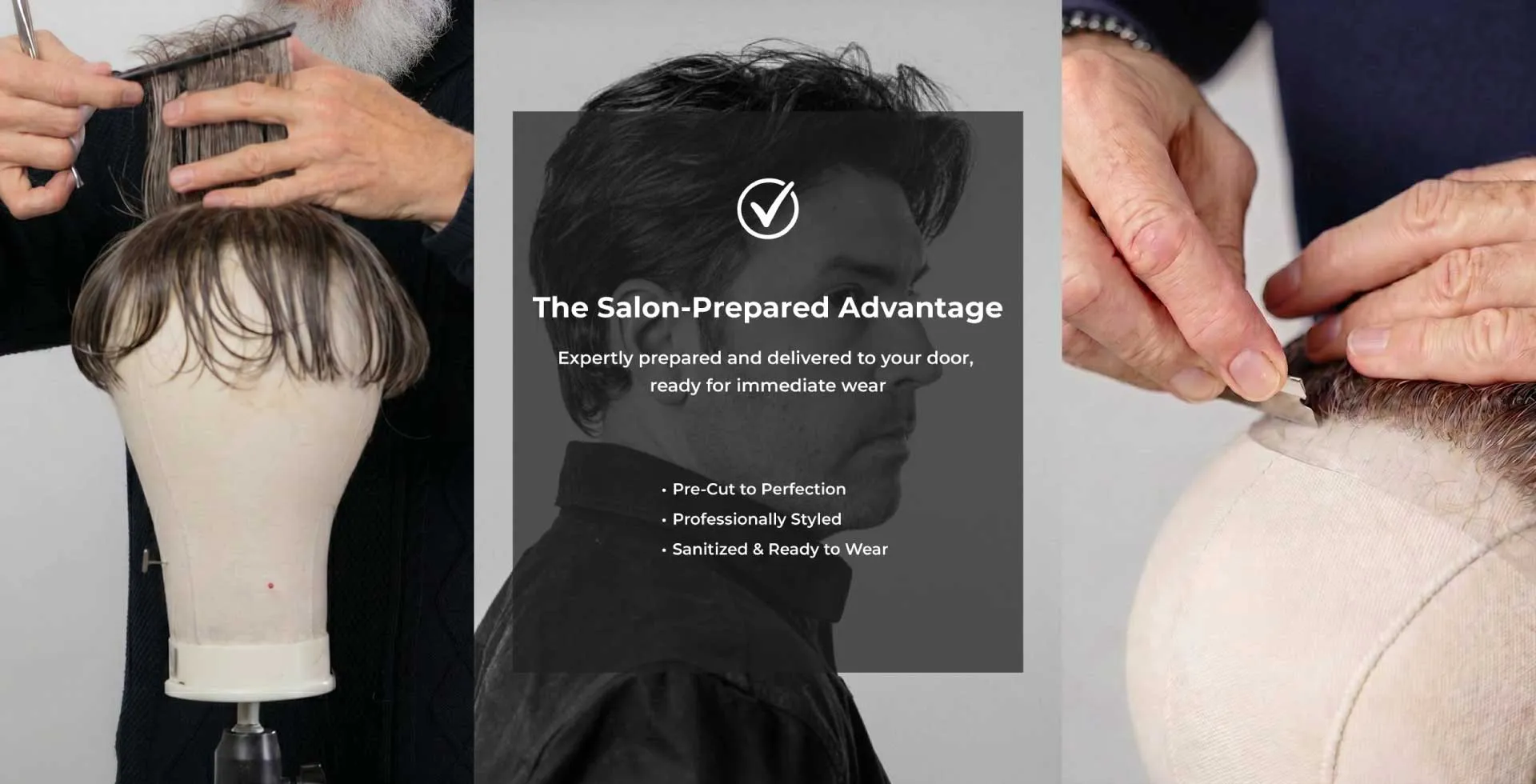
Alternatively, we could prepare a ready-to-wear salon-prepared system for you that you can wear straight out of the box.
How do you compare densities between brands?
You can't compare percentages reliably across brands. Ask for photos of the exact model on a real client, check what base it uses, and if you're new, start with the brand's lighter option.
What density is right for my age?
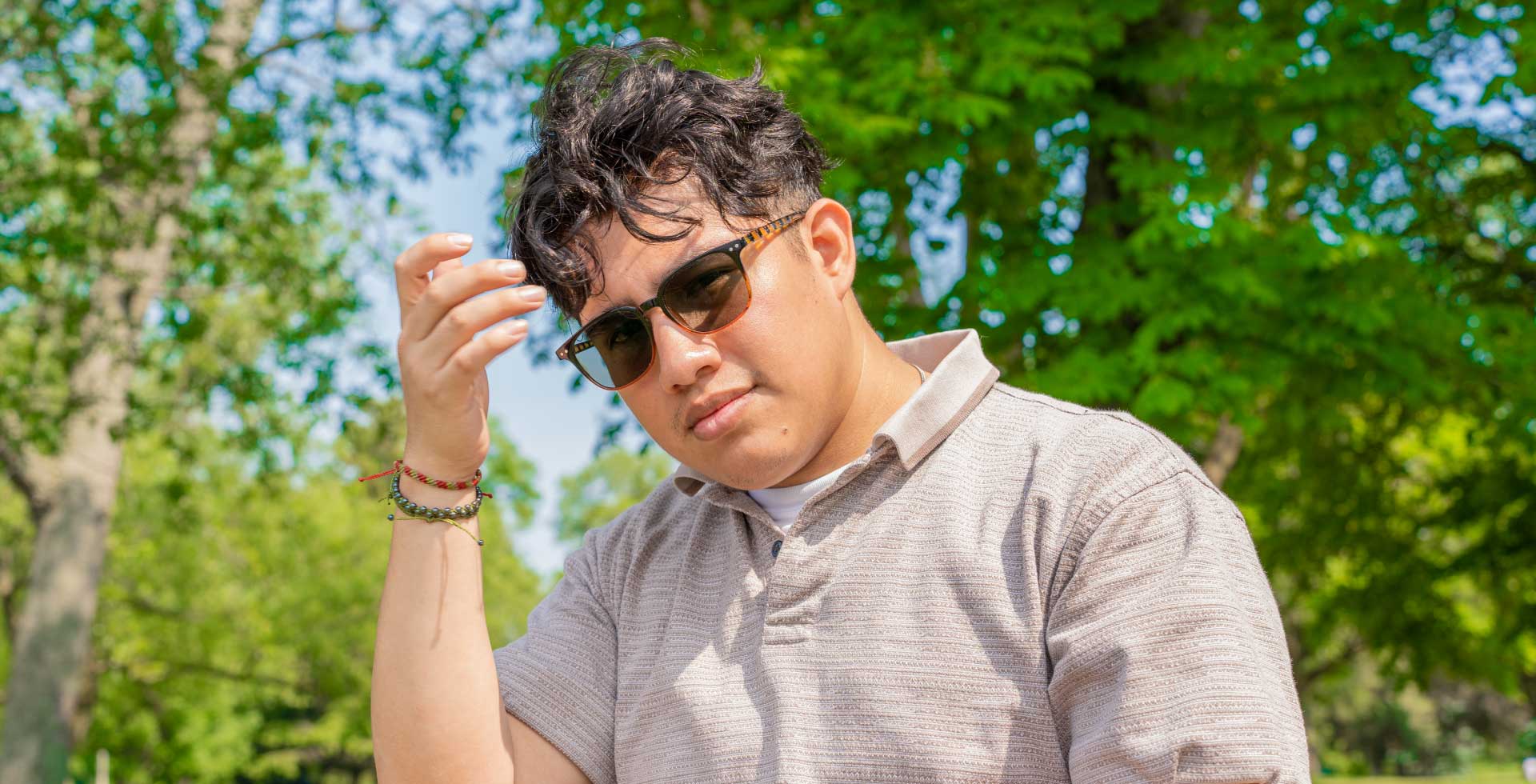
Age gives you a rough guide, but your own hair and style should decide your density, not your birth year. A 20-year-old can have hair as fine as an 80-year-old's, and vice versa.
"You have to be very cautious about recommending a 20-year-old with 80-year-old density, something like 120%," Christina says. The exception is a deliberate style, such as a low skin fade with a fuller top, which some barbers do on purpose.
That said, age matters for realism. Christina sees many older clients in very thick systems because that's what hair replacement looked like when they started. "Who at 60 has that much hair?" Christina asks. "Even a hair transplant won't give you that much." For clients in their 60s, 70s, and 80s, she leans toward natural bases like skin and a density that suits their own hair, including their grey.
A system much denser than what's typical for your age is more likely to look like a hairpiece.
What density should first-time wearers choose?
Start with a lighter density that still matches your bio hair, then build up with each new system. Going straight from little hair to a full, heavy unit shocks you and everyone who sees you.
"If you put something very dense on them, it's a huge shock. They come back and say, 'Thin it out more, thin it out more.' And the more you thin it, the more sparse the haircut looks," Christina says. "There's nothing wrong with starting lighter and gradually building your way up."
A gradual approach means friends notice you "looking better" rather than growing a full head of hair overnight. Once you're comfortable, your next system can be a little fuller and more durable, like if you're on a hair growth serum or medication, so that no one will doubt the increase over time.
Our consultants tell first-time wearers the same thing: it can take a few systems to find the one that best suits your lifestyle and the look you want.
Experienced wearers usually already know their preferred density and model so that they can order directly or gradually step up.
What density is best for fine or thin natural hair?
Match your own density as closely as you can, and choose the thinnest base available. If your hair is finer than even our lightest systems, a stylist can thin the unit a little, but heavy thinning causes problems.
Over-thinning leaves short hairs that stick up and won't lie flat, says Christina. "I'd rather cut it to the correct density and do minimal thinning than do maximum thinning and ruin a system," she says.
Christina has moved several clients from very light densities to the standard M111 or the HD111, which they found more natural. The M115 (90%, with 100% at the front) is a popular lighter choice.
Does hair texture change what density looks natural?
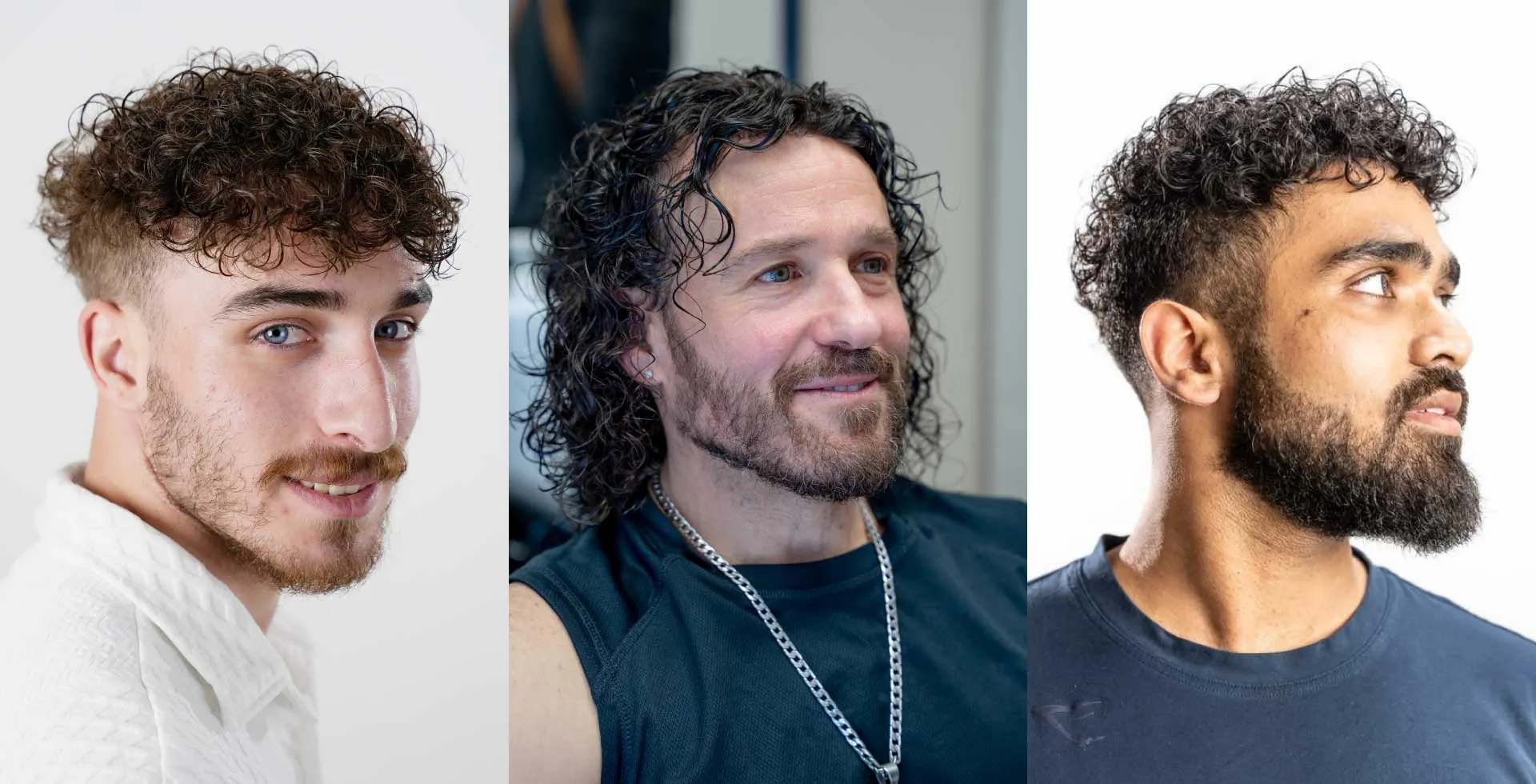
Yes, curly hair looks fuller than straight or wavy hair at the same density, and the tighter the curl, the fuller it looks. Any texture can look natural as long as the system matches your own hair's texture.
"Curly hair always looks fuller," Christina says. "Even if it's the same percentage, it's going to be fuller if it's curlier, because it's all squished together." So if you want more fullness, a tighter curl pattern can give it without adding density. Keep in mind that curls loosen with wear over time.
Our curl patterns range from afro (the tightest, around 4–6 mm) to 18, 22, and 25 mm curls. If none match your natural pattern, we can perm a system in-house. What never works is mixing textures. "Don't put a curly piece on a client with straight bio hair, or vice versa," Christina says.
Does hair color change what density looks natural?
Christina applies the same rule to color. She matches the system to your own hair color rather than dyeing your hair to match the system. "If they're salt and pepper, embrace it," Christina says. Dyed bio hair shows a disconnect as soon as it grows out and means more maintenance. She also avoids coloring the system itself where she can, because a coloured system fades faster and wears out sooner. Finding a system that already matches is the better option.
Color also affects how dense a system looks. Density can look thinner when there's high contrast between your hair color and skin tone, such as dark hair on fair skin, because the scalp shows through more. Matching color closely helps any density look fuller and more natural.
Does density need to change for different hairstyles?
Most hairstyles can be achieved at any density, but high-volume or messy textured styles need enough hair to hold their shape. "If it's too thin, the hair won't stay up because there's not enough weight to hold the style," Christina says. A slicked-back or brushed style is fine at lighter densities.
If you want a skin fade, keep it low. You still need some hair around the perimeter for the system to blend into.
Many of our systems include added density in the front or top for styling needs.
Does face shape affect hair system density?
No, face shape affects your haircut, not your density. Christina hasn't seen density recommended by face shape in practice. For a round face, height on top, such as a pompadour, helps lengthen the face. That comes from the cut and styling, not from adding more hair.
Should lifestyle or climate change my density?
No. Gym, sweat, swimming, and humid climates affect which base and adhesive you choose, not your density. Active wearers often prefer breathable lace, but plenty of very active clients wear skin systems for four weeks or more between maintenance.
"Everybody's scalp chemistry is so different," Christina says. "One adhesive can last a client four weeks, and for you maybe only two." The strongest adhesive on paper isn't always the strongest for you.
A note on breathability: Swiss and French lace are the most breathable, followed by mono (still woven so that air can pass), with skin the least. As Christina points out, your scalp doesn't breathe the way your lungs do; the real issue is sweat and adhesive build-up, which is why the right base and good maintenance matter.
Should density vary across the hairline, crown and back?
Many of our stock systems carry about 10% more hair at the front, and for most wearers that difference is too small to notice. The extra front density gives more room for styling and a buffer against shedding, since the hairline gets the most wear from frontal maintenance and clean-ups.
The zone clients actually notice is the crown. "The crown, where they part, is always so dense, and they always want that part thinned down," Christina says. If crown density bothers you, a stylist can thin that area, or you can order a custom system with zone-by-zone density.
Not every model follows the same pattern, so it's worth checking before you buy. The M158 carries extra hair on the top and crown rather than the front; the MD105 is 110% all over, and the M104 is actually lighter at the front than behind.
Do Superhairpieces systems come with a graduated hairline?
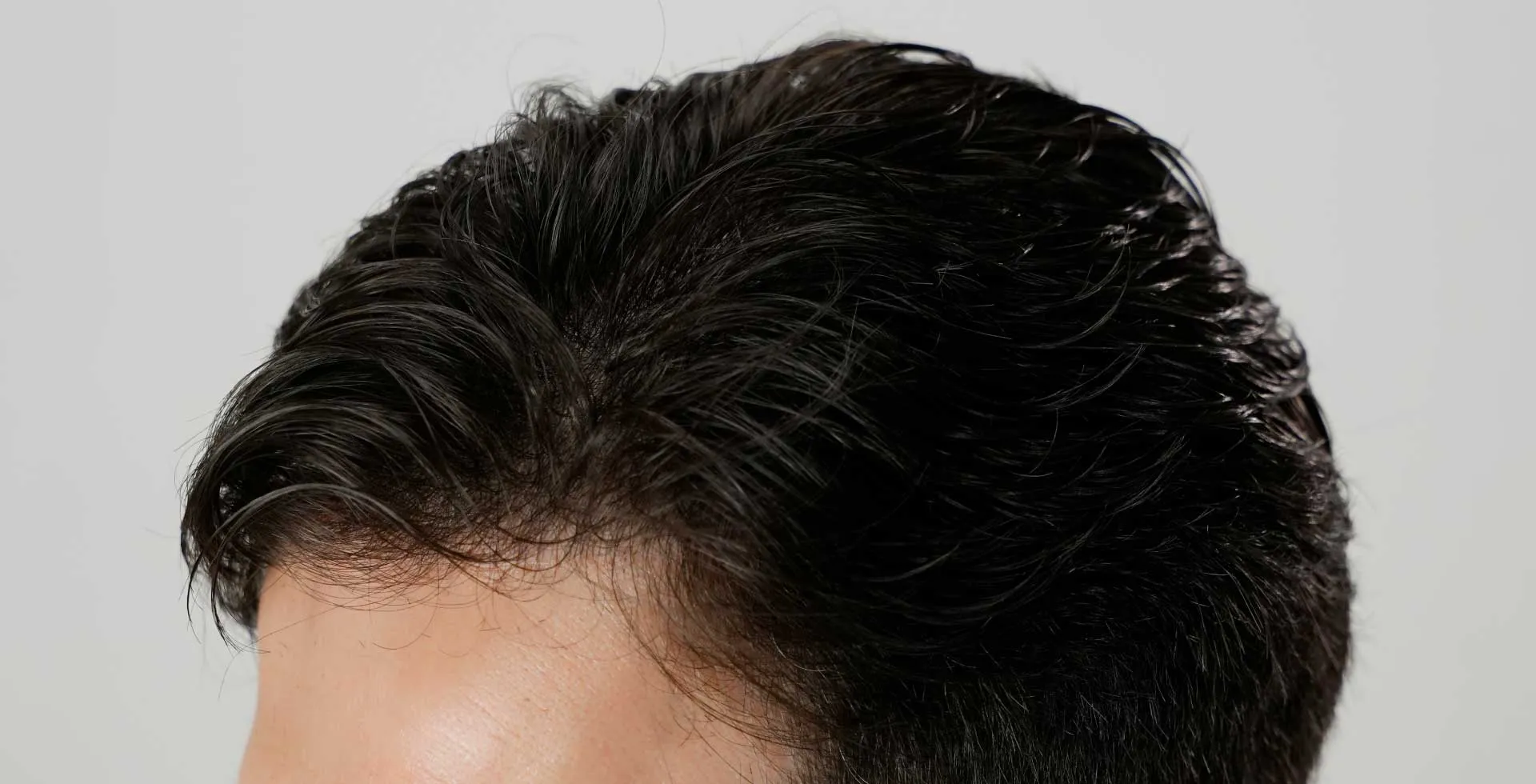
Our hairlines are graduated, but evenly and cleanly rather than in the irregular way natural hairlines grow. A more random, "plucked" hairline can be requested as a custom option.
If I'm between two densities, which should I choose?
Go with the lighter one. If the two options are close, for example, the M115 (90%) and the M105 (100%) — a stylist can thin the heavier one slightly, so either works. When the gap is bigger, as with the M105 (100%) versus the HD105 (120%), the difference in density and visible knots is noticeable. "I would go with the lighter," Christina says. "I don't think I would go more dense."
What's the most common density mistake new wearers make?
Choosing a system that's too dense, for durability. Heavier systems last longer and cost less to maintain, which is tempting when hair replacement is expensive. But they often look unnatural, and they take longer to settle.
Christina sees this most with occasional wearers who use clips or tape and remove the system at night. "They come back and complain: thin it down more, thin it down more. I'm like, you're not wearing it enough for it to settle." Every new system starts a little poofy; regardless of how long you've worn one, it takes regular wear to train the hair.
Will a higher density make me look fuller and younger?

No. Looking younger comes from having hair that looks natural, not from having more of it. As Christina puts it: "Having more hair doesn't make you look younger, but having hair does."
A very dense system on an older wearer tends to look like a hairpiece. The goal is density that believably belongs to you, at your age, with your own sides and back.
If I choose low density, will it look like I'm balding?
Only if it's lighter than your own hair or the base is too thick. Low density goes wrong in two ways: the system is lighter than your bio hair, or the base shows through. Matching your own density and choosing a thin base prevents both. If a system starts shedding enough to show the base, it's time to replace it.
Real questions from hair system wearers, answered.
We pulled these straight from hair system communities online and put them to Christina.
"My stylist recommended 120% density, but people online say go lower for a first system. Who's right?"
Both can be; it depends on your own hair. If your bio hair is naturally dense, 120% can blend perfectly. If it isn't, starting lower and building up looks more natural. "Having it gradual is a lot more natural, because then people won't say you grew a Chia Pet on your head overnight," Christina says. Ask your stylist how 120% compares with the hair on your sides and back.
"My natural hair is super thin. Do I match density to my hair or go a bit higher so it looks fuller?"
Match it to your hair if you want it to blend. "If it's denser on top and your own hair is so thin, you're going to see the contrast," Christina says. "There's only so much thinning can do." You can go heavier if that's what you prefer, but expect a more visible difference between the system and your own hair.
"How much does density matter if the hair is curly vs. straight?"
It matters less than you'd think, because curls add visual fullness on their own. A curly system at the same percentage looks noticeably fuller than a straight one, and tighter curls look fuller still. Match the curl to your own texture, and you may find you need less density than you expected.
Hair system density FAQs
What is the most natural-looking density for a men's hair system?
For many men, the most natural density matches your own hair and falls between 90% and 100% on a thin skin or Swiss lace base.
What density is considered low for a hair system?
Around 90% or below is generally considered low density. Our lightest stock systems start at about 75%.
Is 100% density too thick for a hair system?
Not usually. 100% is a light-to-medium density that looks natural on many wearers, especially on skin or Swiss lace. On a mono base, it will look heavier.
Is 120% density too much for a first hair system?
It is for most first-time wearers unless their own hair is naturally dense. Starting lighter and building up looks more natural.
Can I customize the density of my hair system?
Yes. With a custom order, you can set density zone by zone: front, top, crown, temples, sides, back, and parting line. Custom orders can also go denser than our stock options, as long as the base can hold it.
Can a stylist make a system less dense?
Yes, a stylist can thin a system during the cut. Light thinning works well, but heavy thinning can leave short hairs that stick up and gaps that show the base.
Can I thin my hair system myself?
We don't recommend it. Thinning shears in inexperienced hands can leave gaps, uneven lengths, and short hairs that stick up, and the damage can't be undone. Have a stylist who works with hair systems thin it for you, or contact our customer support team to see what we can do.
I ordered two units with the same density. Why don't they look the same?
That's normal. Every hair system is hand-ventilated from scratch by a skilled worker, so no two units are identical, even with the same model and density. Small differences between orders are expected.
What if the density isn't right when my system arrives?
Check it before you cut or wear it. You can return or exchange unworn stock systems in their original condition and packaging within our 30-day return window. Any alteration makes a system final sale, including a base cut, haircut, bleached knots, or perm, and custom orders are always final sale. If a new, unworn unit's density doesn't match its listing, contact customer support; they may ask for photos or the unit back for inspection. See our full shipping, returns, and warranty policy.
This is another reason Christina recommends a consultation for first-time wearers: it's the easiest way to get density right before anything is cut.
Should I choose a stock or custom system for the right density?
Stock systems come with a set density and ship quickly, so they're ideal if you need a system soon. Custom orders let you choose your density, including by zone, but take longer to make.
Should I keep the same density if I wear systems with different bases?
Ideally, yes, so your look stays consistent. Some bases only suit certain densities, though, so you may need to adjust slightly when switching between, for example, a skin base and a lace base.
Does density affect how long a hair system lasts?
Yes. Higher density on a thicker base lasts longer, while lighter density on a thinner base looks more natural but needs replacing sooner. Heavy density only lasts when the base can carry it.
Not sure which density is right for you?
Every head of hair is different, and density numbers only tell part of the story. Book a consultation in one of our salons or online with a Superhairpieces stylist like Christina, who will review your hair, talk through your style and lifestyle, and recommend the system and density that will look like yours.
Book your consultation →Online Professional Hair System Consultation for Hair Pieces

 Likes
Likes